Sisyphus, the man who denounced the king, cheated death and stopped the war
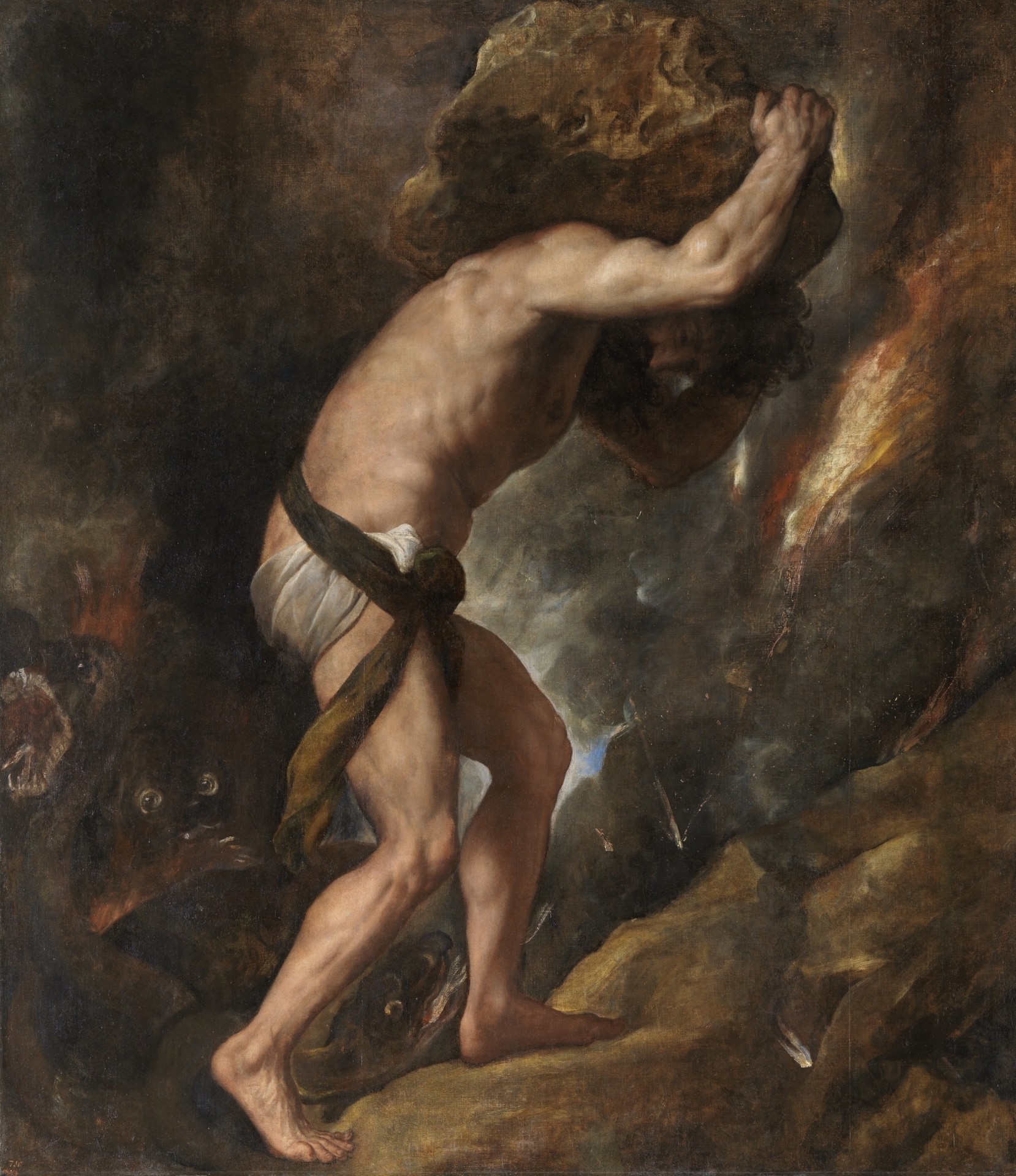
Titian: Sisyphus, 1548–1549. Oil on canvas, 237 x 216 cm - Museo Nacional del Prado
Sisyphus and water
Sisyphus’s relationship with water originates in a specific episode of his myth.
Sisyphus, founder and king of Ephyra (later known as Corinth), witnessed the abduction of the nymph Aegina by the god Zeus. When Asopus, the god of rivers and Aegina’s father, came to Corinth in search of his daughter, Sisyphus saw a unique opportunity to benefit his kingdom. He offered Asopus to reveal his daughter’s whereabouts in exchange for making a spring of fresh water gush forth in Corinth. Asopus agreed to the bargain and gave life to the Pirene spring, a source of vital water for life in the ancient city of Corinth.
Sisyphus and death
Zeus, enraged at having been denounced, sent Thanatos, the personification of death, to take Sisyphus to the underworld. Sisyphus managed to trick Thanatos and chained him up, thus preventing death from performing its function. As a result, for a time no one died on Earth. The situation reached such an extreme that Hades, the god of the underworld, demanded that Zeus solve the problem. Zeus, furious at Sisyphus’s trick, sent Ares, the god of war, to free Thanatos and take Sisyphus to the underworld. Ares carried out his mission, freed Thanatos and escorted Sisyphus to the underworld, making sure that this time the cunning king could not escape his punishment.
But Sisyphus was able to trick Hades into allowing him to leave the underworld and return to the world of the living. Sisyphus’s cunning revealed itself when, before his death, he instructed his wife not to perform the usual funeral rites. On reaching the underworld, Sisyphus complained that his wife had not fulfilled her duties and convinced Hades to let him return to earth to put the situation right. Once back among the living, Sisyphus refused to return to the underworld, living to a ripe old age.
The punishment
This act of defiance against the natural and divine order was what finally led the gods to impose on him the famous punishment of having to push a rock uphill for all eternity, only to watch it roll back down each time it neared the summit. A fate similar to that of Prometheus, condemned for stealing fire from the gods and giving it to humans1.
This punishment is usually interpreted as a metaphor for the futility and incessant effort of human life, interrupted only by death. But here I’d like to frame this punishment within a relationship of power between classes. Sisyphus, who denounced the king, cheated death and stopped the war, always acted for a cause. He was condemned by the highest degree of power —the king of the gods— with a torment that looks more like an abuse and a revenge against an unsubmissive rebel.
- Sísifo - Wikipedia, la enciclopedia libre
- El mito de Sísifo - La Mente es Maravillosa
- CEPPAS | Otra vuelta de tuerca al mito de Sísifo
- El mito de Sísifo: interpretaciones y representaciones en el arte y la literatura - Cultura Genial
- Aguas subterráneas en la encrucijada: El mito de Sísifo | iAgua
- La piedra de Sísifo
- Sísifo - Enciclopedia de la Historia del Mundo
- Sísifo y la muerte - Revista de Prensa
- El mito de Sísifo y su significado en el mundo actual: Los mitos en Latinoamérica: Bolívar, José Martí y Fidel Castro. Desdén y anemia de los mitos nacionales: Lautaro y La Araucana
- Albert Camus: “El mito de Sísifo” - Altea Psicólogos
- Prometeo - Wikipedia, la enciclopedia libre
- Mito de Prometeo – filosofiatb
-
Prometheus was chained to a mountain in the Caucasus so that an eagle would devour his liver for all eternity. ⤶